 |
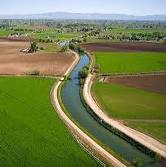
| Irrigation ditch |
I don't know about where you live, but here in MA, many towns have either total outdoor water bans or bans allowing watering on alternating days. As a result, there are many brown lawns. But the flowers and the garden need water to be viable. So we set our timers to irrigate the flowers and gardens. Luckily irrigation today is much different than how humans used to irrigate :)
It's not hard to figure out that irrigation goes way back to when humans first began to settle areas and grow their own food. Humans most likely began irrigating by filling buckets in rivers or lakes, and carrying it on their head, or on poles to water crops. But water is heavy, and even with the help of donkey or oxen, it is too difficult to carry enough water to irrigate large fields. So humans figured out ways to make irrigation easier.
Historians know that ancient Egyptians built mud-brick reservoirs to trap and hold the water from the Nile River. They also had a network of irrigation canals that filled with water during the flood and were refilled from the reservoirs. Egyptians built shadufs to lift the water from the canal up to the fields. A shaduf is a large pole balanced on a crossbeam, a rope and bucket on one end and a heavy counter weight at the other. The rope lowered the bucket into the canal were it was filled with water, then the farmer raised the bucket, swung the pole around and emptied the bucket onto the field.
 |
| Example of terracing |
The Incas created artificial lagoons, and carved out terraces into the steep mountains. The terracing helped the Incas to take advantage of gravity, and water flowed down the terraces to irrigate the crops.
 |
| Roman aqueduct |
Romans are famous for their aqueduct systems which were used for irrigation as well as drinking water. Aqueducts are man-made conduits to carry water. Their systems used tunnels within the hillsides to bring water for irrigation to the plains below. The elaborate system that served the capital of the Roman Empire, really is a major engineering achievement. 11 aqueducts were built over a period of 500 years (312 BC to AD 226), and brought water to Rome from as far away as 57 miles. A portion of the aqueduct system crossed over valleys on stone arches, but most of the system was underground conduits made of stone and terra cotta pipe, but also of wood, leather, lead, and bronze. Water flowed to the city by the force of gravity alone and usually went through a series of distribution tanks within the city. But I digress!
 |
| spray irrigation |
 |
| drip irrigation |
So what can be done to irrigate home gardens and flowers when facing water bans, or if you just want to reduce your water use, and water bill? Timers are helpful to make sure that areas are not over or under-watered. Soaker hoses are an option to reduce water use by about 90% compared to conventional watering. Some are made from recycled materials. Although I have used soaker hoses in the past for flower beds, I have had problems with pin holes that quickly become geysers, and I'm not sure I would want to use them in the garden since they are made from recycled tires, and may leach heavy metals, lead, cadmium, etc., into the soil like the recycled tire mulches.
Many gardening catalogs have fancy but expensive rain barrels, which can collect from 50-100 gallons of water from rainwater. Water collects from rainwater that pours down the roof into the gutters, down the drainpipe, and into to the water barrel. I'm not sure if during the quick trip down the rooftop if any chemicals from the shingles would cause problems or not, so it may be best to use the collected water for flowers and not for veggies. At any rate, I've been wishing for a rain barrel and looking up how to make your own rain barrel online, and there are quite a few options, even some that are made from trash can. I'd love to reduce our water use, still be able to water the flowers, and capturing free rainwater instead of paying the water company!
 |
| rain barrel |
This past weekend, my wish came true and while visiting family in NH and walking around the local "Olde Home Weekend" where I spied rain barrels. So of course I had to check out the booth. To my delight, there were directions and parts to make a rain barrel from food grade barrels available locally. I asked about buying the parts from the young man at the booth and he offered to make one while we watched. I couldn't believe my luck! The rain barrels are being promoted by the New Hampshire Coastal Protection Partnership to help reduce nitrogen levels in the Lamprey River and the Great Bay Estuary (to learn more, check out info at www.nhcoast.org or www.lampreyriver.org.) Increases in nitrogen levels have negative impacts on drinking water, fish, animals, plants, and their economy. So it felt great to make a donation for the rain barrel constructed while we watched, and knowing that it goes to a great environmental cause.
I is for inspiring causes such as the New Hampshire Coastal Protection Partnership, and ingenious irrigation...using rainwater collected in a recycled rain barrel, made in NH and now residing in MA!
sources: http://www.allabouthistory.org/aztec-civilization.htm
http://en.wikipedia.org/wiki/Incan_agriculture
http://www.woodlands-junior.kent.sch.uk/Homework/egypt/farming.htm
http://www.historyforkids.org/learn/economy/farming/irrigation.htm
http://www.crystalinks.com/romeaqueducts.html
http://ga.water.usgs.gov/edu/irmethods.html


